


Achilles tendinopathy · rehabilitation
Achilles Tendinopathy: Should You Rest or Exercise?
Achilles pain has an annoying habit of behaving reasonably while you are sitting down and then reminding you of its existence the moment you get out of bed, start walking or try to run.
The short answer
You might notice stiffness during your first few steps in the morning, pain when pushing off while walking, or discomfort that appears during or after running and sport.
One possible cause is Achilles tendinopathy.
The Achilles tendon is the large tendon connecting your calf muscles to your heel. It deals with substantial force during walking, running, jumping and changing direction.
When the tendon becomes painful and its ability to tolerate load is reduced, simply avoiding it indefinitely is rarely the complete answer.
Modern Achilles rehabilitation generally focuses on managing aggravating loads and progressively rebuilding the tendon and calf's capacity through exercise.
What is Achilles tendinopathy?
Achilles tendinopathy is a condition involving pain and impaired function of the Achilles tendon.
It commonly develops gradually rather than following one dramatic injury.
You may notice:
- pain or tenderness around the Achilles tendon
- stiffness when getting out of bed
- pain when beginning to walk after sitting
- discomfort during or after running
- reduced ability to jump or push off
- pain during calf raises
- reduced confidence returning to sport.
Symptoms can occur in the middle portion of the tendon or closer to where the Achilles attaches to the heel.
That distinction can matter because exercise selection and loading may need to be modified according to where symptoms are located.
Achilles tendon pain differs from pain underneath the heel. Our guide to plantar heel pain explains that pattern.
Why does Achilles tendinopathy develop?
There is rarely one single cause.
A common theme is that the amount or type of load placed on the tendon changes faster than the tendon is currently prepared to tolerate.
For example, symptoms might appear after you:
- suddenly increase your running distance
- add more running sessions each week
- start sprint training
- introduce hill running
- return to sport after time off
- substantially increase jumping
- start a new gym program
- suddenly become much more active.
Sometimes the change is less obvious.
Your overall training might look similar, but recovery, work demands, sleep, other health factors or the intensity of individual sessions may have changed.
The important question is therefore not simply:
“What exercise damaged my Achilles?”
A more useful question is:
“What is my Achilles currently able to tolerate, and what does it need to tolerate for me to return to my normal activity?”
That becomes the basis of rehabilitation.
Is Achilles tendinopathy the same as an Achilles tear?
No.
Achilles tendinopathy usually develops gradually and is different from an acute Achilles tendon rupture.
A rupture may occur suddenly during sport or activity and can be associated with a sensation of being kicked or struck in the back of the leg, sometimes with a pop and immediate difficulty walking or pushing off.
A suspected Achilles rupture requires prompt medical assessment.
If your symptoms developed gradually and you can still walk and use the leg, the presentation may be different, but an individual assessment is still important when the diagnosis is unclear.
Should you rest Achilles tendinopathy?
Complete rest is generally not the goal for most people with Achilles tendinopathy.
If running, jumping or another activity is repeatedly causing a substantial flare-up, temporarily reducing that activity may be appropriate.
But reducing load is different from removing all load.
Your tendon needs to tolerate force to perform everyday activities, and eventually it needs sufficient capacity for whatever sport, work or exercise you want to return to.
This means rehabilitation often involves load modification rather than complete rest.
For a runner, that might mean temporarily changing:
- weekly running distance
- running frequency
- speed sessions
- hills
- sprinting
- recovery between sessions.
For someone who doesn't run, the relevant loads may instead be prolonged walking, stairs, work activities or gym training.
The aim is to find a manageable starting point rather than repeatedly aggravating the tendon or wrapping the entire leg in metaphorical bubble wrap.
Should you exercise an Achilles tendon that hurts?
Exercise is a major component of rehabilitation for many people with Achilles tendinopathy.
Current clinical practice guidelines for midportion Achilles tendinopathy recommend tendon-loading exercise as a first-line treatment to improve pain and function.
Importantly, this isn't simply stretching.
The tendon and calf need progressively appropriate resistance.
The exact program depends on your current capacity, symptoms and goals.
What exercises are used for Achilles tendinopathy?
There isn't one magic Achilles exercise.
Rehabilitation usually progresses according to what you can currently tolerate and what you ultimately need to return to.
Calf raise exercises
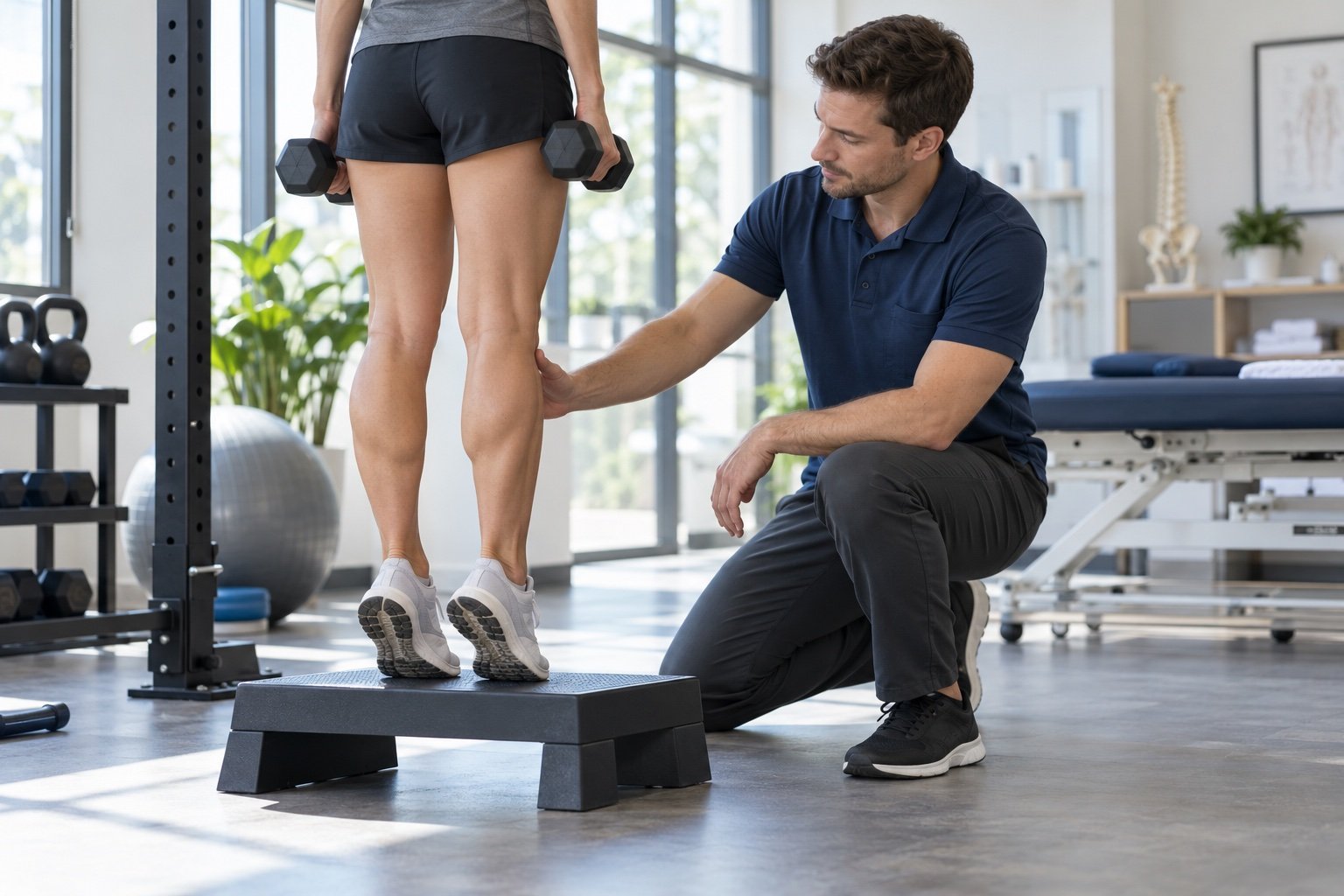
Calf raises are commonly used because they directly load the calf-Achilles complex.
Early options might include:
- seated calf raises
- double-leg standing calf raises
- supported calf raises.
As capacity improves, rehabilitation might progress towards:
- single-leg calf raises
- externally loaded calf raises
- heavier seated calf raises
- exercises through greater ranges of movement where appropriate.
The goal isn't to remain on the easiest exercise forever.
Progressive loading gives the calf and tendon a reason to adapt.
Heavy resistance exercises
Some people may progress to heavier resistance exercises using gym equipment, dumbbells, a Smith machine or other resistance.
This can be particularly useful when the person's eventual goals require higher levels of strength.
A runner, footballer or field-sport athlete generally needs substantially more Achilles capacity than is required to perform ten easy calf raises beside the kitchen bench.
Faster loading
Later rehabilitation may introduce quicker movements where appropriate.
This can include progressively preparing for:
- hopping
- jumping
- running
- acceleration
- deceleration
- changing direction.
These exercises aren't necessarily appropriate at the beginning.
They become relevant when the person has developed sufficient strength and tolerance.
Do eccentric heel drops still work?
You may have seen the classic Achilles exercise where the heel is slowly lowered over the edge of a step.
Eccentric exercises can still be useful, but they are not the only legitimate way to rehabilitate Achilles tendinopathy.
Current guidance supports tendon-loading exercise, which can include different types of progressive resistance rather than requiring every patient to follow one identical eccentric protocol.
The important principles are appropriate loading, progression and consistency.
Exercise selection should also consider whether symptoms are in the middle of the tendon or closer to its attachment at the heel.
How often should you exercise?
The appropriate frequency depends on the program and the individual.
For midportion Achilles tendinopathy, current clinical practice guidelines recommend tendon-loading exercise at least three times per week at an intensity as high as tolerated.
That doesn't mean blindly loading the tendon as heavily as possible from day one.
Your starting point should reflect your symptoms and physical capacity.
As strength improves, resistance can be progressively increased.
Is pain during Achilles exercises okay?
Some discomfort during tendon rehabilitation may be acceptable for certain people.
The useful question isn't simply whether you felt anything during the exercise.
Your physiotherapist may also consider:
- how much pain occurred
- whether symptoms settled afterwards
- how the tendon feels later that day
- morning stiffness the following day
- changes in walking tolerance
- changes in calf strength
- your response to running or sport.
If your symptoms become progressively worse from session to session, the total load may need adjusting.
That could involve changing the resistance, repetitions, exercise frequency or other activities you're performing.
Rehabilitation shouldn't become a competition to see how much pain you can tolerate.
It also shouldn't involve avoiding every exercise that produces the slightest sensation.
Should you stretch your Achilles?
Stretching isn't automatically required for everyone.
Whether calf stretching is appropriate depends partly on your presentation and where your Achilles symptoms are located.
For some people, particularly those with pain near the tendon attachment at the heel, repeatedly forcing the ankle into deeper dorsiflexion may aggravate symptoms.
This is one reason copying a generic Achilles program from the internet can be less useful than having the problem assessed.
The exercise that is appropriate for one Achilles presentation may need modifying for another.
Can you keep running with Achilles tendinopathy?
Sometimes.
Having Achilles tendinopathy doesn't automatically mean running must stop completely.
The decision depends on:
- symptom severity
- your current running volume
- how symptoms respond during running
- how the tendon responds afterwards
- morning symptoms the following day
- your current strength
- your training goals.
Some runners may continue with a reduced or modified running program while completing rehabilitation.
Others may benefit from temporarily replacing some running with lower-impact conditioning before gradually rebuilding their running volume.
The goal is to manage the total load on the tendon while maintaining as much appropriate activity as possible.
What about heel lifts and orthotics?
Heel lifts may sometimes be used temporarily as part of Achilles management.
Current clinical guidelines state that heel lifts may be considered for people with midportion Achilles tendinopathy to temporarily reduce ankle dorsiflexion during activity.
Orthotics are less straightforward. Current guidelines report conflicting evidence and do not make a recommendation for or against orthoses for midportion Achilles tendinopathy.
Neither should automatically replace progressive rehabilitation.
They are tools that may or may not be useful depending on the individual.
Do you need an ultrasound or MRI?
Not everyone with Achilles pain requires imaging.
A clinical assessment can often provide useful information about whether symptoms are consistent with Achilles tendinopathy.
Imaging may be considered if:
- the diagnosis is unclear
- symptoms followed significant trauma
- a tear is suspected
- symptoms are unusual
- progress isn't occurring as expected.
Even when imaging shows tendon changes, the scan still needs to be interpreted alongside your symptoms and physical function.
A structurally imperfect tendon isn't automatically a useless tendon.
Read our guide on when an X-ray or scan may be helpful.
How long does Achilles tendinopathy take to improve?
Tendon rehabilitation generally requires patience.
The exact timeframe varies according to factors including:
- how long symptoms have been present
- current strength
- running or sporting demands
- work demands
- consistency with rehabilitation
- how much aggravating load can be modified
- other health factors.
Some people notice improvements relatively early, but rebuilding sufficient capacity for higher-level running or sport can take considerably longer.
A useful rehabilitation plan therefore focuses on progressive improvements in strength and function rather than promising that everyone will be fixed within an arbitrary number of weeks.
When should you see a physiotherapist?
Consider having Achilles pain assessed if it:
- isn't improving
- keeps returning
- affects walking
- limits running
- prevents you playing sport
- makes calf raises difficult
- causes noticeable weakness
- becomes increasingly painful
- leaves you unsure about how much exercise is appropriate.
A physiotherapist can assess whether the presentation appears consistent with Achilles tendinopathy and identify an appropriate starting point for rehabilitation.
What might physiotherapy involve?
Your physiotherapist may ask about when symptoms began, changes in training, your work, footwear, running or sporting demands and what activities currently aggravate symptoms.
Assessment may include:
- ankle movement
- calf strength
- single-leg calf raises
- walking
- hopping where appropriate
- functional or sporting tasks
- your current training load.
Treatment may involve education, load modification, progressive exercise rehabilitation and other physiotherapy strategies where clinically appropriate.
For someone returning to running or sport, rehabilitation can then progress beyond basic exercises towards the strength and physical demands required for that activity.
Learn more about physiotherapy in Moorebank.
Achilles tendinopathy physiotherapy in Moorebank
If Achilles pain is affecting your walking, running, gym training or sport, One Stop Physio Moorebank provides physiotherapy at 132 Nuwarra Road, Moorebank NSW 2170.
The Moorebank clinic provides physiotherapy with Christian Tarabey and Simon De Biasi, as well as Exercise Physiology with Hadi Youssef.
The clinic supports patients from Moorebank, Liverpool, Chipping Norton, Hammondville, Wattle Grove and surrounding South West Sydney.
Rehabilitation can be tailored to your current capacity and goals, whether you are trying to comfortably walk again, return to the gym or rebuild towards running and sport.
Frequently asked questions
Should I rest completely with Achilles tendinopathy?
Usually not. Activity that significantly aggravates symptoms may need to be reduced temporarily, but progressive tendon-loading exercise is recommended as a first-line treatment for midportion Achilles tendinopathy.
What is the best exercise for Achilles tendinopathy?
There isn't one best exercise for everyone. Progressive calf and Achilles loading is commonly used, with exercises selected and progressed according to your symptoms, strength and goals.
Can I run with Achilles tendinopathy?
Some people can continue running with modifications, while others may need to temporarily reduce their running. The decision should consider symptoms during and after running, morning stiffness, current strength and overall training load.
Are heel drops the only treatment for Achilles tendinopathy?
No. Eccentric heel drops are one loading option, but modern rehabilitation can use different forms of progressive tendon-loading exercise.
When should Achilles pain be assessed urgently?
Seek prompt medical assessment if you experience sudden pain or a pop in the Achilles region with immediate weakness or difficulty pushing off, particularly during sport or activity, as an Achilles rupture needs to be considered.
Sources and further reading
This article provides general health information and does not replace individual medical or physiotherapy assessment.
Ready to have your Achilles pain assessed?
If Achilles pain is stopping you from walking, training or playing sport comfortably, book a physiotherapy assessment at One Stop Physio Moorebank.