


FOOT & HEEL PAIN · PLANTAR FASCIITIS
Plantar Fasciitis: What Helps Heel Pain?
You get out of bed, put your foot on the floor and immediately regret having feet. The first few steps are painful underneath your heel. After walking around for a while, it starts to ease. Then you sit down for an hour, stand up again and the heel reminds you that the problem is very much still there.
The short answer
That pattern is commonly associated with plantar heel pain, often referred to as plantar fasciitis. The plantar fascia is a strong band of tissue running underneath your foot from the heel towards the toes. It helps support the arch of the foot and deals with considerable load during standing, walking and running.
When the area becomes painful, normal activities such as walking to work, exercising, standing through a shift or simply getting out of bed can become surprisingly unpleasant. Healthdirect identifies pain underneath the heel as the main symptom of plantar fasciitis and notes that symptoms are commonly worse during the first steps in the morning, after prolonged sitting or standing, and following substantial activity.
Fortunately, plantar heel pain can usually be managed without simply stopping everything and waiting for your foot to reconsider its behaviour.
What does plantar fasciitis feel like?
The typical symptom is pain underneath or around the heel. It may feel sharp, aching or occasionally burning. A particularly recognisable pattern is pain when you first stand after being inactive.
You may notice it:
- during your first steps in the morning
- when standing after sitting for a long time
- after spending hours on your feet
- during or after running
- after increasing your walking
- when walking barefoot on hard floors
- following a change in exercise or footwear.
Some people find the heel loosens up once they start walking, only for symptoms to return later. Healthdirect describes this first-step pain as a common feature of plantar fasciitis.
What causes plantar heel pain?
There usually isn't one villain. Plantar heel pain can develop when the loads placed through the foot exceed what the tissues are currently accustomed to tolerating. Sometimes this follows a noticeable change.
Perhaps you've recently:
- started running
- increased your running distance
- started doing more walking
- changed jobs and now stand all day
- returned to sport
- increased jumping or gym training
- changed shoes
- started exercising after a period of inactivity.
Healthdirect identifies running, dancing, aerobics and jumping activities among potential contributors, particularly when someone suddenly increases their activity or begins a new form of exercise. Spending substantial time standing and having tight or weak calf muscles are also recognised factors.
That doesn't mean running is inherently bad for your feet. The issue is often the relationship between load and current capacity. Going from very little running to four sessions a week because a fitness app has developed strong opinions about your lifestyle is quite different from gradually building your training over time.
Is a heel spur causing the pain?
Not necessarily. Heel spurs are commonly associated with plantar fasciitis, which understandably makes them an easy target when one appears on an X-ray. However, many people have heel spurs without experiencing pain. Healthdirect specifically notes that heel spurs can exist without causing symptoms.
An imaging finding therefore needs to be interpreted alongside your symptoms and physical assessment. The presence of a spur doesn't automatically mean something needs to be removed, shaved or otherwise subjected to power tools.
Should you stop walking with plantar fasciitis?
Usually, management is more nuanced than either keep doing absolutely everything or stop using the foot entirely. If your current walking, running or work demands are repeatedly causing major symptom flare-ups, temporarily reducing the amount of load may help.
For example, you might temporarily modify:
- running distance
- running frequency
- long walks
- jumping activities
- prolonged barefoot walking
- activities involving extended standing.
But prolonged complete rest isn't generally the long-term solution. The goal is to find a level of activity your foot can currently tolerate and then progressively build from there. Healthdirect recommends gradually introducing activities such as running and allowing adequate recovery between physical activities.
What exercises help plantar fasciitis?
There isn't one exercise that every person with heel pain needs. Exercise selection depends on your symptoms, physical assessment and the activities you're trying to return to. A rehabilitation program may address several areas.
Plantar fascia and calf mobility
Stretching may be appropriate for some people. This can include specific plantar fascia stretches as well as calf stretching where relevant. Healthdirect includes stretching exercises among conservative management options for plantar fasciitis.
Calf strengthening
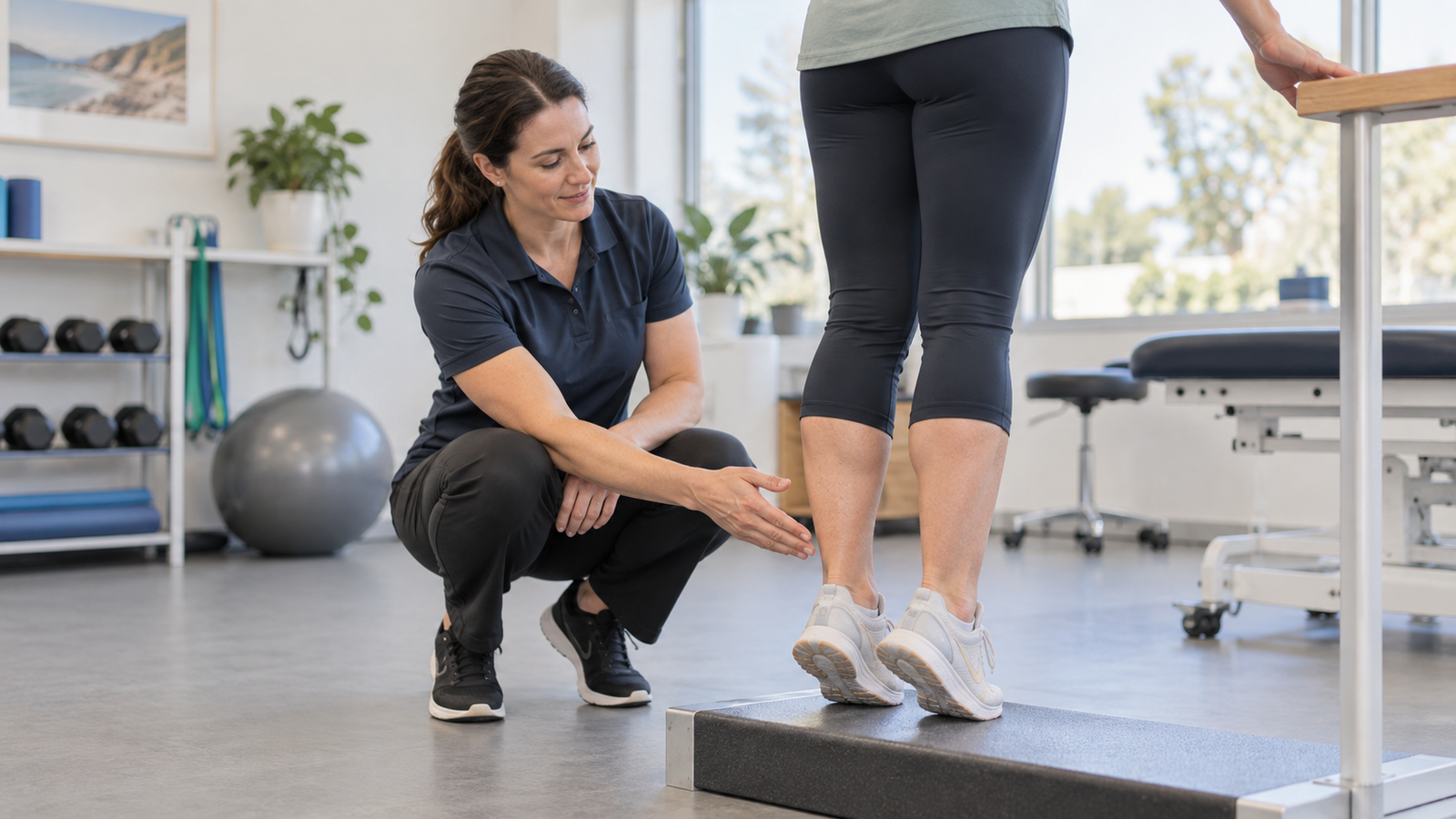
Your calf muscles and Achilles tendon play an important role in walking, running and absorbing force. Depending on your assessment, progressive calf strengthening might involve exercises such as:
- seated calf raises
- standing calf raises
- double-leg calf raises
- single-leg calf raises
- progressively loaded calf exercises.
The starting exercise should reflect what you can currently tolerate. Someone who has substantial pain simply standing isn't going to begin at the same level as a runner who can already perform 20 single-leg calf raises.
Foot strengthening
Exercises targeting the smaller muscles of the foot may also form part of rehabilitation in some cases. Healthdirect notes that strengthening the calf and smaller muscles of the foot may be used when treating heel pain.
Gradual return to meaningful activity
Eventually, rehabilitation needs to prepare you for what you actually want to do. For one person, that may simply mean comfortably completing a full workday on their feet. For another, it might mean returning to:
- running
- football
- netball
- gym training
- hiking
- long-distance walking.
Doing a few stretches in the lounge room can be useful, but at some point your foot needs enough capacity to tolerate the activity you're asking it to perform.
How much pain is acceptable during exercise?
This depends on your individual presentation. A physiotherapist may consider not only discomfort during an exercise but also how the heel responds afterwards.
Useful questions include:
- Did symptoms settle after exercise?
- Was the heel substantially worse later that day?
- Was first-step pain noticeably worse the next morning?
- Is walking becoming easier over time?
- Are strength and activity tolerance improving?
If a particular exercise repeatedly creates a substantial flare-up, the dose may need to be adjusted. That could mean changing the resistance, repetitions, range, frequency or total activity around the exercise.
Rehabilitation is not improved by pretending pain doesn't exist. It also isn't improved by becoming frightened of every sensation in your heel.
What shoes are best for plantar fasciitis?
Footwear can influence symptoms. Healthdirect recommends supportive, cushioned footwear as one conservative management option for plantar fasciitis. Heel pads, arch supports and taping may also be considered. That doesn't mean every person needs expensive custom orthotics.
Footwear decisions should consider:
- what feels comfortable
- the activity you're doing
- how much time you spend standing
- your current symptoms
- your usual footwear
- whether changing footwear alters symptoms.
If walking barefoot on hard floors clearly aggravates your heel, temporarily using comfortable supportive footwear around the house may be reasonable. The best shoe is not automatically whichever one has accumulated the most marketing jargon.
Do orthotics fix plantar fasciitis?
Orthotics or arch supports can be useful for symptom management in some people, but they aren't necessarily the entire solution. Healthdirect includes heel pads and arch supports among conservative options.
If an insert makes walking more comfortable, that may help you remain active while addressing other relevant factors such as strength and activity progression. Whether an off-the-shelf support or another approach is appropriate depends on the individual.
Do you need an X-ray or ultrasound?
Often, no. Plantar heel pain can frequently be diagnosed based on your symptoms and physical assessment. Healthdirect notes that an X-ray or ultrasound may sometimes be used to rule out other causes, but imaging is often not necessary for diagnosing plantar fasciitis.
Imaging may become more relevant if symptoms are unusual, there has been significant trauma, another diagnosis is suspected or your progress isn't following the expected pattern.
How long does plantar fasciitis take to settle?
Plantar heel pain can be frustratingly persistent. Healthdirect notes that plantar fasciitis can last for weeks or months.
How long recovery takes varies according to factors such as:
- how long symptoms have been present
- work demands
- activity levels
- recent changes in training
- strength and physical capacity
- whether aggravating loads can be modified
- consistency with rehabilitation.
A heel that has been painful for six months shouldn't necessarily be expected to transform after three days of stretching. Human tissue remains disappointingly uninterested in our preferred deadlines.
When should you see a physiotherapist?
Consider having persistent heel pain assessed if it:
- isn't improving
- repeatedly returns
- makes walking difficult
- limits your work
- stops you exercising
- affects sport
- changes the way you walk
- leaves you unsure about what exercise is appropriate.
Healthdirect advises seeking medical assessment when plantar fasciitis symptoms persist beyond eight weeks and notes that physiotherapists can assess causes of heel pain. You don't necessarily need to wait eight weeks if symptoms are significantly affecting your daily activities.
A physiotherapy assessment can also help determine whether your symptoms actually appear consistent with plantar heel pain or whether another cause should be considered.
When does heel pain need more urgent assessment?
Not every painful heel is plantar fasciitis. Heel pain can have other causes including Achilles problems, stress fractures, nerve-related pain and other conditions.
Seek prompt medical assessment if you experience sudden severe heel or calf pain during activity, particularly if you felt or heard a pop, as an Achilles tendon rupture needs to be considered. You should also seek appropriate medical advice for significant trauma, severe swelling, redness, fever, neurological symptoms or other unusual symptoms.
Plantar fasciitis physiotherapy in Moorebank
If heel pain is making walking, working or exercise difficult, physiotherapy can help determine what is contributing to your symptoms and establish an appropriate rehabilitation plan.
One Stop Physio provides physiotherapy in Moorebank at 132 Nuwarra Road, Moorebank NSW 2170, with Christian Tarabey and Simon De Biasi providing physiotherapy at the clinic. Private physiotherapy appointments do not require a referral.
The One Stop Physio Moorebank clinic supports patients from Moorebank, Liverpool, Chipping Norton, Wattle Grove, Hammondville and surrounding South West Sydney suburbs.
Assessment may consider your foot and ankle movement, calf strength, walking, activity levels, work demands, footwear and the activities you're trying to return to. The aim isn't simply to make your heel less sore for an afternoon. It's to help you progressively rebuild the capacity required for walking, work, exercise or sport.
If persistent heel pain is limiting your day, book a physiotherapy assessment at One Stop Physio Moorebank.
Frequently asked questions
Why is plantar fasciitis worse in the morning?
Pain during the first steps after getting out of bed is a common feature of plantar fasciitis. Symptoms can also worsen when standing after a prolonged period of sitting or following substantial activity.
Should I keep walking with plantar fasciitis?
You may need to temporarily reduce activities that significantly aggravate your heel, but completely stopping all activity isn't necessarily required. The appropriate amount of walking depends on your symptoms and how the heel responds afterwards.
What exercises are good for plantar fasciitis?
Rehabilitation may include plantar fascia or calf stretching, calf strengthening and exercises targeting the muscles of the foot. The appropriate starting point and progression depend on your individual symptoms and activity goals.
Do I need orthotics for plantar fasciitis?
Not everyone does. Heel pads or arch supports can help manage symptoms for some people, but they are usually considered alongside footwear, activity modification and rehabilitation rather than automatically being the only treatment.
Do I need a scan for heel pain?
Often not. Plantar fasciitis can frequently be assessed from your history and examination. Imaging may be considered when another cause needs to be ruled out or the presentation is unusual.
Sources and further reading
Important: This article provides general health information and does not replace individual medical or physiotherapy assessment.
Ready to have your heel assessed?
If persistent heel pain is limiting your day, book a physiotherapy assessment at One Stop Physio Moorebank.