


Knee pain · knee rehabilitation
Knee Pain Going Downstairs: Causes and Exercises
Knee pain when walking downstairs is a common problem that can make everyday activities surprisingly uncomfortable.
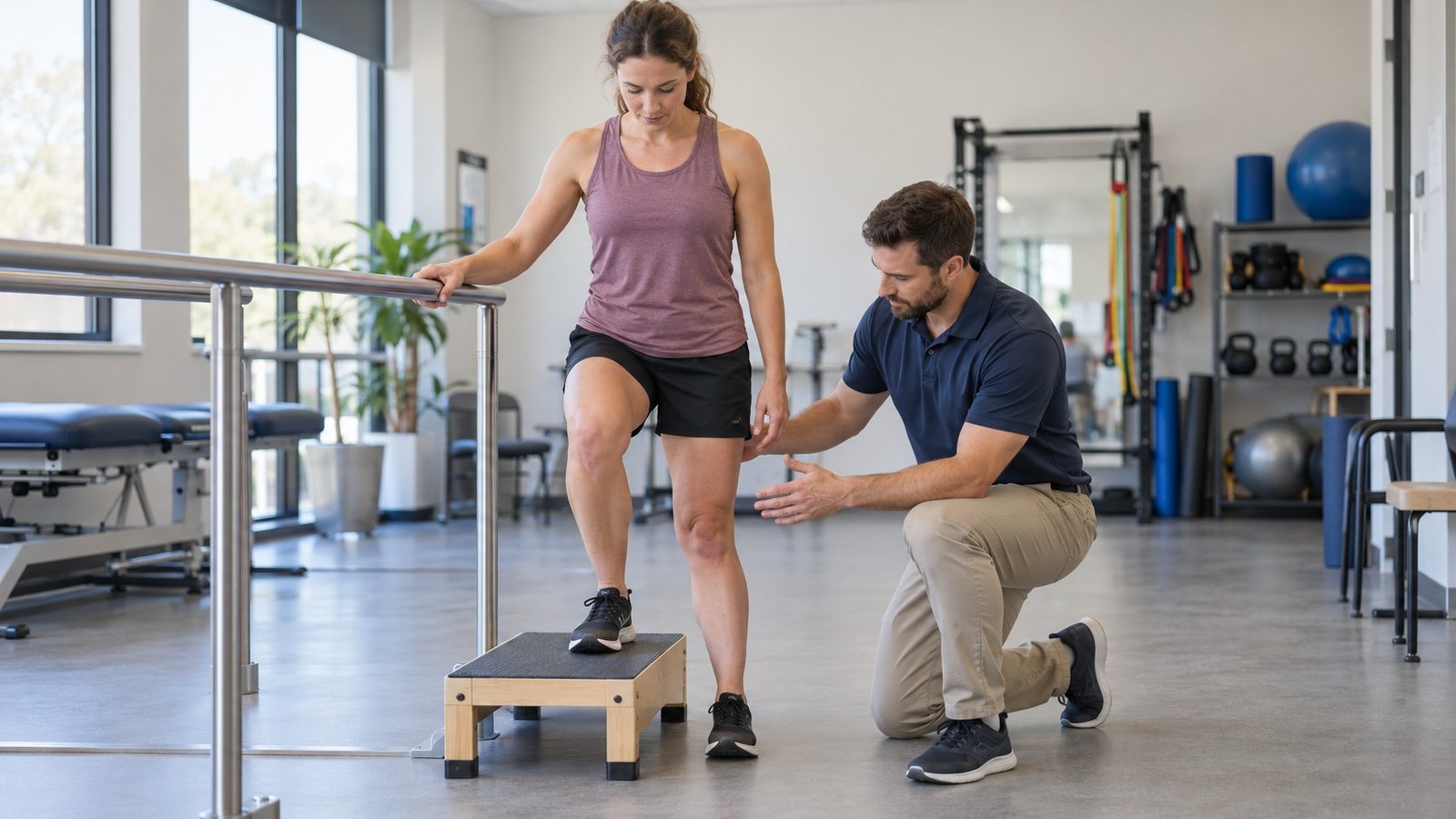
You might feel relatively comfortable walking on flat ground but notice pain around your kneecap when descending stairs. For some people, the discomfort is mild. For others, it makes them avoid stairs altogether.
You may also experience symptoms when squatting, running, getting out of a chair or sitting with your knees bent for long periods.
One possible explanation is patellofemoral pain, which commonly causes discomfort around or behind the kneecap.
However, knee pain on stairs can have several causes. Understanding where your pain is located, how it started and which activities aggravate it can help guide appropriate management.
The short answer
Knee pain when going downstairs is often associated with increased loading around the kneecap.
Patellofemoral pain is one common cause, particularly when symptoms occur around or behind the kneecap during activities such as squatting, running or stair climbing.
Other possible causes include knee osteoarthritis, patellar tendon problems or injuries involving the meniscus and other joint structures.
Management depends on the underlying condition.
For many people with patellofemoral pain, education, appropriate activity modification and progressive strengthening can help improve symptoms and function.
Why does my knee hurt more going downstairs than upstairs?
Walking downstairs places different demands on your knee compared with walking on flat ground.
As you lower yourself onto the next step, the muscles at the front of your thigh, known as the quadriceps, help control your body weight.
This requires the quadriceps to work while lengthening, a type of muscle action called an eccentric contraction.
At the same time, the kneecap and surrounding structures experience loading as the knee bends.
If the knee is sensitive to this amount of load, descending stairs may become uncomfortable.
This does not automatically mean something is damaged.
It may indicate that the current demands of the activity exceed what your knee can comfortably tolerate.
However, the location of your pain, injury history and associated symptoms remain important when determining the cause.
What causes knee pain when walking downstairs?
Several conditions can cause pain during stair descent.
1. Patellofemoral pain
Patellofemoral pain is a common cause of discomfort around or behind the kneecap.
The patellofemoral joint is where the kneecap meets the thigh bone.
This joint experiences loading during activities that involve bending the knee while supporting body weight.
Symptoms may become noticeable when:
- Walking downstairs
- Squatting
- Running
- Climbing hills
- Getting out of a chair
- Sitting with the knees bent for prolonged periods
Patellofemoral pain can develop gradually, sometimes following an increase in running, gym training or other physical activity.
It is not necessarily caused by the kneecap being incorrectly positioned.
Strength, activity levels, movement patterns and individual sensitivity to loading may all contribute.
2. Knee osteoarthritis
Knee osteoarthritis can also cause pain during stair climbing.
It is more common with increasing age and may be associated with stiffness, swelling and reduced movement.
Some people notice discomfort when getting up from a chair or after sitting for prolonged periods.
Although osteoarthritis involves changes within the joint, the severity of those changes does not always match the amount of pain experienced.
Exercise and strengthening are commonly recommended as part of management.
For more information, read our existing article on exercise for knee osteoarthritis.
3. Patellar tendinopathy
The patellar tendon connects the kneecap to the shin bone.
Patellar tendinopathy commonly causes pain around the tendon, often just below the kneecap.
It may occur in people who participate in sports involving repeated jumping, landing or running.
Symptoms can also become noticeable during squats and stair climbing.
Management generally involves adjusting aggravating activities and progressively rebuilding the tendon’s capacity through appropriate exercise.
4. Meniscus or other knee injuries
The menisci are cartilage structures within the knee that help distribute load.
A meniscus injury may occur following a twisting movement, although degenerative changes can also develop gradually.
Symptoms can include joint-line pain, swelling, catching or difficulty bending and straightening the knee.
Not every meniscus injury requires surgery, but the appropriate treatment depends on the presentation.
A knee that becomes genuinely locked, particularly after an injury, requires prompt medical assessment.
What can you do if your knee hurts on stairs?
The first step is to identify which activities are aggravating your symptoms.
For many people with gradually developing knee pain, completely avoiding movement is unnecessary.
Instead, temporarily modifying the amount of loading may help.
Use the handrail
Using a handrail can reduce the demands placed on your knee and improve confidence while descending stairs.
This may be particularly helpful during a painful flare-up.
Take one step at a time
If normal stair descent is uncomfortable, try stepping down one step at a time.
When using this approach, leading with the painful leg when descending allows the stronger or less painful leg to provide more support as you lower yourself.
This can be a temporary strategy while your knee improves.
Reduce aggravating activity temporarily
If you have recently increased running, squatting or stair climbing, consider whether that change contributed to your symptoms.
Reducing the volume or intensity for a short period may help.
The goal is not to avoid those activities permanently.
It is to find a manageable starting point and progressively rebuild your capacity.
What exercises can help knee pain going downstairs?
For people with patellofemoral pain, strengthening the quadriceps and hip muscles is commonly recommended.
However, exercise selection should reflect your diagnosis, symptoms and current ability.
The following are examples of exercises that may be included in a rehabilitation program.
They are not a universal prescription.
1. Sit-to-stand exercises
Sit-to-stands are a useful way to introduce controlled loading through the legs.
Start by sitting on a stable chair.
Place your feet comfortably on the floor and stand up using your legs.
Slowly return to the seated position.
The difficulty can be adjusted by changing the chair height, using your hands for support or increasing the number of repetitions.
As strength improves, the exercise can be progressed.
2. Step-ups
Step-ups help develop strength and control during a movement similar to stair climbing.
Start with a low, stable step.
Step onto the platform using the affected leg, then return to the starting position in a controlled manner.
A handrail or stable support can be used if needed.
The height of the step and the amount of support can be adjusted according to your symptoms.
3. Controlled step-downs
Step-down exercises can be particularly relevant when your main difficulty is walking downstairs.
Begin on a low step with access to a stable handrail.
Slowly lower your opposite foot towards the ground while controlling the movement through your supporting leg.
Return to the starting position.
This exercise can be challenging, so it may need to be introduced later in rehabilitation.
Reducing the step height or using additional support can make the movement more manageable.
4. Hip strengthening
The muscles around the hip help control the pelvis and lower limb during walking, running and stair climbing.
Depending on your assessment, rehabilitation may include:
- Standing hip abduction
- Side-lying hip exercises
- Resistance-band exercises
- Single-leg balance
- Progressive lower-limb strengthening
Hip strengthening may be particularly useful when combined with knee-focused exercises.
The appropriate combination depends on your individual presentation.
Is some pain during exercise acceptable?
Some mild discomfort during rehabilitation may be acceptable.
However, the amount of discomfort and how your symptoms respond afterwards are important.
Consider whether:
- Pain settles after completing the exercise.
- Symptoms are substantially worse later that day.
- Your knee is more painful the following morning.
- Swelling increases.
- Walking and stair climbing are gradually becoming easier.
If an exercise repeatedly causes significant or prolonged symptom flare-ups, the program may need adjusting.
This could involve changing the resistance, repetitions, range of movement or frequency.
The aim is to progressively improve strength and tolerance without consistently aggravating the knee.
Should you avoid stairs completely?
Not necessarily.
For many people, temporarily modifying stair climbing is more appropriate than avoiding it indefinitely.
If your knee becomes painful after repeatedly climbing stairs, reducing the number of trips may help.
Using a handrail, taking one step at a time or adjusting your pace can also make the activity more manageable.
As symptoms improve, you can gradually return to your normal stair-climbing routine.
The goal is to restore confidence and function rather than develop a permanent fear of using stairs.
Do you need an MRI for knee pain?
Not everyone experiencing knee pain requires an MRI.
For many presentations of gradually developing patellofemoral pain, a clinical assessment can provide enough information to begin appropriate management.
A physiotherapist may assess:
- The location of your pain
- How symptoms developed
- Knee movement
- Quadriceps and hip strength
- Squatting
- Step-down control
- Walking
- Relevant hip and ankle function
Imaging may be appropriate when there is concern about a significant injury, fracture, another underlying condition or symptoms that are not progressing as expected.
A scan result should be interpreted alongside your symptoms and clinical examination.
For more information, read our guide on when an X-ray or scan may be helpful after an injury.
How long does knee pain take to improve?
Recovery depends on the underlying condition and individual circumstances.
Some people notice improvements after modifying aggravating activities and starting an appropriate strengthening program.
Others may require several months of rehabilitation, particularly when symptoms have been present for a long time.
Factors that can influence recovery include:
- How long symptoms have been present
- Current muscle strength
- Activity levels
- Work and sporting demands
- Previous knee injuries
- Other health conditions
- Consistency with rehabilitation
Progress is not always linear.
Some fluctuations in symptoms may occur as activity levels increase.
The important consideration is whether your overall function and tolerance are gradually improving.
When should you see a physiotherapist?
Consider a physiotherapy assessment if:
- Knee pain repeatedly affects stair climbing.
- Symptoms are not improving.
- You are avoiding normal activities because of pain.
- Squatting or running has become difficult.
- You are unsure which exercises are appropriate.
- Pain is limiting your work, sport or daily activities.
Seek urgent medical assessment if you experience severe pain following a significant injury, cannot bear weight, develop marked swelling or deformity, or have a hot, red knee accompanied by fever or feeling unwell.
A genuinely locked knee or rapidly worsening symptoms also warrant prompt assessment.
Physiotherapy and Exercise Physiology in Moorebank
One Stop Physio offers both Physiotherapy and Exercise Physiology at our Moorebank clinic. Choose the service that suits your needs and rehabilitation goals.
Physiotherapy
Our physiotherapists assess knee pain, movement and strength, and guide an individual treatment and rehabilitation plan. Treatment may include education, activity modification, progressive strengthening, functional movement retraining and hands-on treatment where clinically appropriate.
Physiotherapy is provided by Christian Tarabey and Simon De Biasi.
Exercise Physiology
Our Exercise Physiologist provides individual exercise assessment and structured exercise programs to build strength, improve movement and progressively develop your capacity for everyday activities, work and exercise.
Exercise Physiology is provided by Hadi Youssef.
One Stop Physio Moorebank is located at 132 Nuwarra Road, Moorebank NSW 2170, supporting patients from Liverpool, Chipping Norton, Hammondville, Wattle Grove and surrounding South West Sydney suburbs.
Frequently asked questions
Why does my knee hurt going downstairs but not upstairs?
Walking downstairs requires the quadriceps to control your body weight as the knee bends. This places demands on the kneecap and surrounding structures. Patellofemoral pain is one possible cause, although other conditions can produce similar symptoms.
Is walking good for patellofemoral pain?
Walking can often remain part of your routine. Distance, terrain and intensity may need adjusting during a flare-up. The aim is to maintain appropriate activity while gradually improving strength and tolerance.
What is the best exercise for knee pain on stairs?
There is no single best exercise for everyone. Quadriceps strengthening, hip strengthening and progressive step exercises are commonly used for patellofemoral pain. Exercise selection should reflect your symptoms and current capacity.
Should I stop squatting if my knees hurt?
Not necessarily. You may be able to continue squatting with adjustments to depth, resistance or repetitions. Significant or worsening symptoms should be assessed before progressing.
Can physiotherapy help knee pain when walking downstairs?
Physiotherapy can help assess the cause of your symptoms and guide appropriate strengthening, activity modification and rehabilitation. Treatment depends on the underlying condition and individual goals.
Sources and further reading
- Neal BS, Lack SD, Bartholomew C, Morrissey D. Best practice guide for patellofemoral pain. British Journal of Sports Medicine. 2024.
- NHS Inform. Patellofemoral Pain Syndrome.
- NHS Inform. Exercises to Help With Patellofemoral Knee Pain.
- Healthdirect Australia. Knee Injuries.
- NSW Agency for Clinical Innovation. Knee Injuries Fact Sheet.
This article provides general health information and does not replace individual medical or physiotherapy assessment.
Book Physiotherapy or Exercise Physiology in Moorebank
If knee pain is affecting stairs, exercise or everyday activities, you can book with either our Physiotherapy team or our Exercise Physiologist at One Stop Physio Moorebank.
Choose your preferred service, practitioner and appointment time through our Moorebank online booking system. If you are unsure which appointment suits you, call the clinic and we can help.
One Stop Physio Moorebank
132 Nuwarra Road, Moorebank NSW 2170
Phone: 0482 047 813