


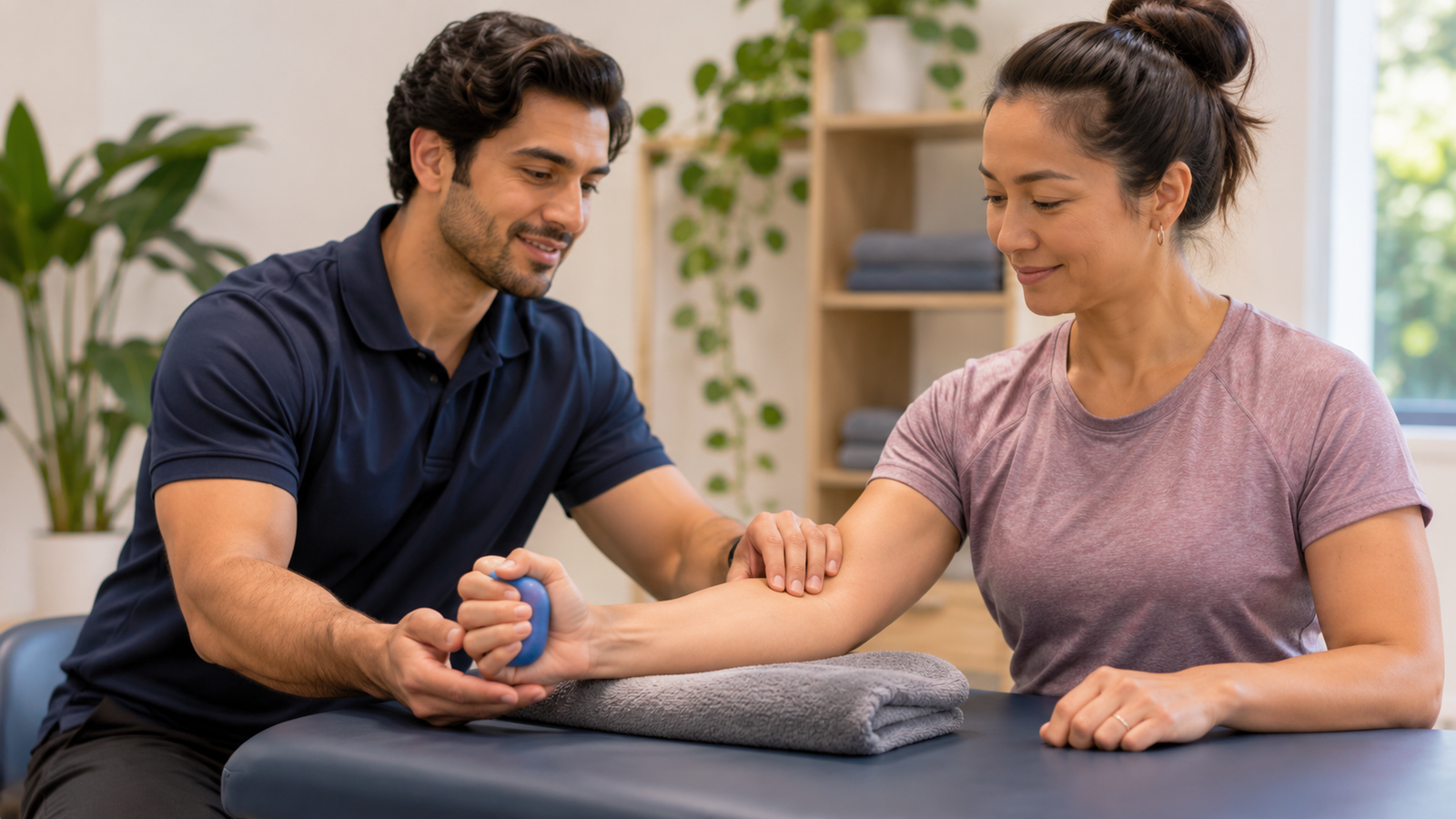
Sports injury · elbow rehabilitation
Tennis Elbow: Why Does Gripping Hurt?
A sore elbow can turn simple jobs—lifting a kettle, carrying shopping, turning a key or gripping a racquet—into a nuisance. Here is what pain on the outside of the elbow may mean and how to build back towards the activities you need.
Despite its name, tennis elbow is not reserved for tennis players. It can affect people whose work, sport or hobbies involve repeated gripping, lifting or wrist movement. The medical terms lateral elbow tendinopathy and lateral epicondylalgia describe pain around the tendon attachment on the outside of the elbow.
If gripping has become painful, it is tempting either to push through every task or stop using the arm altogether. A more useful plan is to understand the load your arm currently tolerates, adjust aggravating tasks for a while and gradually rebuild strength. Other causes can produce similar symptoms, so an individual assessment matters when the picture is unclear.
The short answer
Gripping activates muscles along the back of your forearm that help steady the wrist. Their tendons attach near the outside of the elbow. When this area is sensitive, gripping, lifting with the palm facing down or twisting an object can reproduce pain. Tennis elbow is one possible explanation; symptoms alone do not confirm the diagnosis. Activity changes and progressive exercise may help, but recovery and the right starting point vary from person to person.
What does tennis elbow usually feel like?
People often point to the bony area on the outside of the elbow. Pain can extend down the forearm, and the hand may feel less reliable when carrying or squeezing objects. It might develop gradually after more work, gardening, gym training or racquet sport than usual, or become noticeable after a particularly demanding day.
- Gripping a cup, handshake or shopping bag may hurt.
- Lifting a pan, tool or child can be uncomfortable, especially with the wrist extended.
- Turning a doorknob, using a screwdriver or opening a jar may provoke symptoms.
- Repeated keyboard, mouse or manual work may become harder to tolerate.
These examples are clues, not a self-diagnosis. Pain elsewhere in the elbow, neck or forearm, or symptoms involving nerves or joints, may need a different approach. Healthdirect’s tennis elbow guide describes common symptoms and when to seek medical advice.
Why does gripping put pressure on the elbow?
When you close your hand firmly, the wrist extensor muscles also work to keep the wrist stable. That means a grip is not only a hand task. Force travels through the forearm muscles and their tendon attachment at the outside of the elbow. If that system is irritable, even an ordinary object can feel surprisingly heavy.
Load is affected by more than the object’s weight. The length of time you hold it, how often you repeat the movement, wrist position, handle size and whether the task happens at the end of a tiring day can all matter. A recent jump in activity may be more relevant than a single “bad” movement. Tennis elbow is often described as an overuse problem, but pain is not a simple measure of tissue damage.
Should you stop gripping and lifting?
Short-term changes can settle a flare without abandoning normal movement. Try splitting a heavy load between two hands, holding an object closer to the body, using a larger or easier-to-grip handle, or taking brief breaks from a repetitive task. At the gym, you may need to reduce the load, number of sets or grip-intensive exercises for a period. A racquet player may need to adjust volume and equipment with appropriate advice.
There is no universal pain score that makes an activity safe or unsafe. Notice whether symptoms settle after the task and how your elbow feels later that day and the next morning. If pain is escalating or a task leaves a prolonged flare, reduce the demand and seek advice. Long periods of complete rest can make returning to normal loads harder; the goal is a tolerable bridge back to activity.
Can exercises help tennis elbow?
Rehabilitation commonly includes exercises for the wrist extensors, grip and the wider arm, progressing towards your actual work or sport. An early program might use comfortable wrist movement and a gentle static hold. Later work may include controlled wrist extension against resistance, carrying, gripping and task-specific loading. The load, repetitions and frequency should match the person’s irritability and current capacity.
A physical therapy clinical practice guideline covers assessment and exercise for lateral elbow tendinopathy. A Cochrane review of manual therapy and exercise found that benefits compared with minimal treatment were small and the evidence uncertain. Exercise is a reasonable part of care, but no one exercise or exact timetable is a guaranteed cure.
A practical progression
First, find a manageable level of everyday use and reduce the tasks that repeatedly cause a strong flare. Next, introduce a tolerable strengthening exercise and build its resistance or volume gradually. Finally, practise the demands you want to return to—whether that means a work shift, lifting at the gym or a full tennis session. A physiotherapist can help decide when to progress and how to respond if symptoms spike.
Do braces, massage or injections fix it?
A forearm strap or brace may make a particular task more comfortable for some people. Manual treatment may offer short-term relief, but neither replaces a plan for managing load and restoring function. Treatment choices should be discussed in the context of your goals, preferences and health history.
If you are considering medication or an injection, speak with a GP or pharmacist about potential benefits and risks. Temporary pain relief does not automatically mean the tendon is ready for its previous workload. Persistent symptoms deserve reassessment rather than simply repeating a treatment that has not helped.
How long does recovery take?
Recovery is variable. Some people improve over weeks with appropriate changes, while others have symptoms for several months. The duration of symptoms, work demands, previous episodes and ability to adjust loads all influence the plan. Healthdirect notes that recovery can be slow and that many cases improve over time.
Measure progress in useful ways: Can you lift the kettle with less discomfort? Finish a shift with fewer flare-ups? Carry more, or play for longer, without a worse next day? These changes are often more meaningful than waiting for a single pain-free date.
When should you get assessed sooner?
Seek prompt medical advice after a significant injury, with marked swelling or deformity, fever, redness and heat, worsening pain, a change in colour of the hand or arm, or new numbness or pins and needles. Those features need a broader assessment. If you cannot use the arm normally or symptoms are not improving, a clinician can check whether tennis elbow is the right explanation and whether imaging or another referral would change care. A scan is not automatically required for a typical presentation; read our guide to when an X-ray or scan may help.
How can physiotherapy help in Moorebank?
An assessment looks at how symptoms began, which gripping tasks hurt, your work and sport demands, and relevant neck, shoulder, elbow and wrist findings. Grip and wrist strength can provide useful starting measures. Your plan may include activity changes, progressive exercises and a graded return to the tasks that matter to you.
At One Stop Physio Moorebank, we can help you work out what your arm currently tolerates and build a realistic progression. Our clinic is at 132 Nuwarra Road, Moorebank, serving people from Moorebank and nearby South West Sydney suburbs. You do not need to be a tennis player to ask for help with a sore elbow.
Frequently asked questions
Can tennis elbow cause pain when lifting a cup?
Yes. Even a light object can hurt when the grip and wrist position load a sensitive tendon. Other causes are possible, especially if the symptoms or location are unusual.
Should I keep exercising if gripping hurts?
Often some activity can continue with changes to load, volume or grip. A strong or lingering flare suggests the task needs adjusting. An individual assessment can help set the starting point.
Do I need an MRI for tennis elbow?
Usually not as a first step. History and examination often guide the initial plan. Imaging may be considered if the diagnosis is uncertain or the result would change management.
Will a brace cure tennis elbow?
A brace may help some people tolerate particular tasks, but it does not replace gradual strengthening and activity planning.
Can tennis elbow come back?
Symptoms may recur when a demanding activity returns faster than capacity has rebuilt. A progressive plan and sensible changes to repetitive tasks may help manage that risk, although no approach guarantees prevention.
Sources and further reading
- Healthdirect Australia: Tennis elbow
- American Physical Therapy Association: Lateral elbow pain clinical practice guideline
- Cochrane: Manual therapy and exercise for lateral elbow pain
This article provides general health information and does not replace individual medical or physiotherapy assessment.
Ready to get your grip back?
If elbow pain is interfering with work, lifting, exercise or sport, book a physiotherapy assessment with our Moorebank team. We can assess your symptoms and help plan a graded return to your activities.