


Sports injury · hamstring rehabilitation
Hamstring Strain Recovery: When Can You Run Again?
A hamstring strain can happen in an instant. You might be sprinting for the ball, accelerating during a game or increasing your running speed when you suddenly feel a sharp pain or pulling sensation in the back of your thigh.
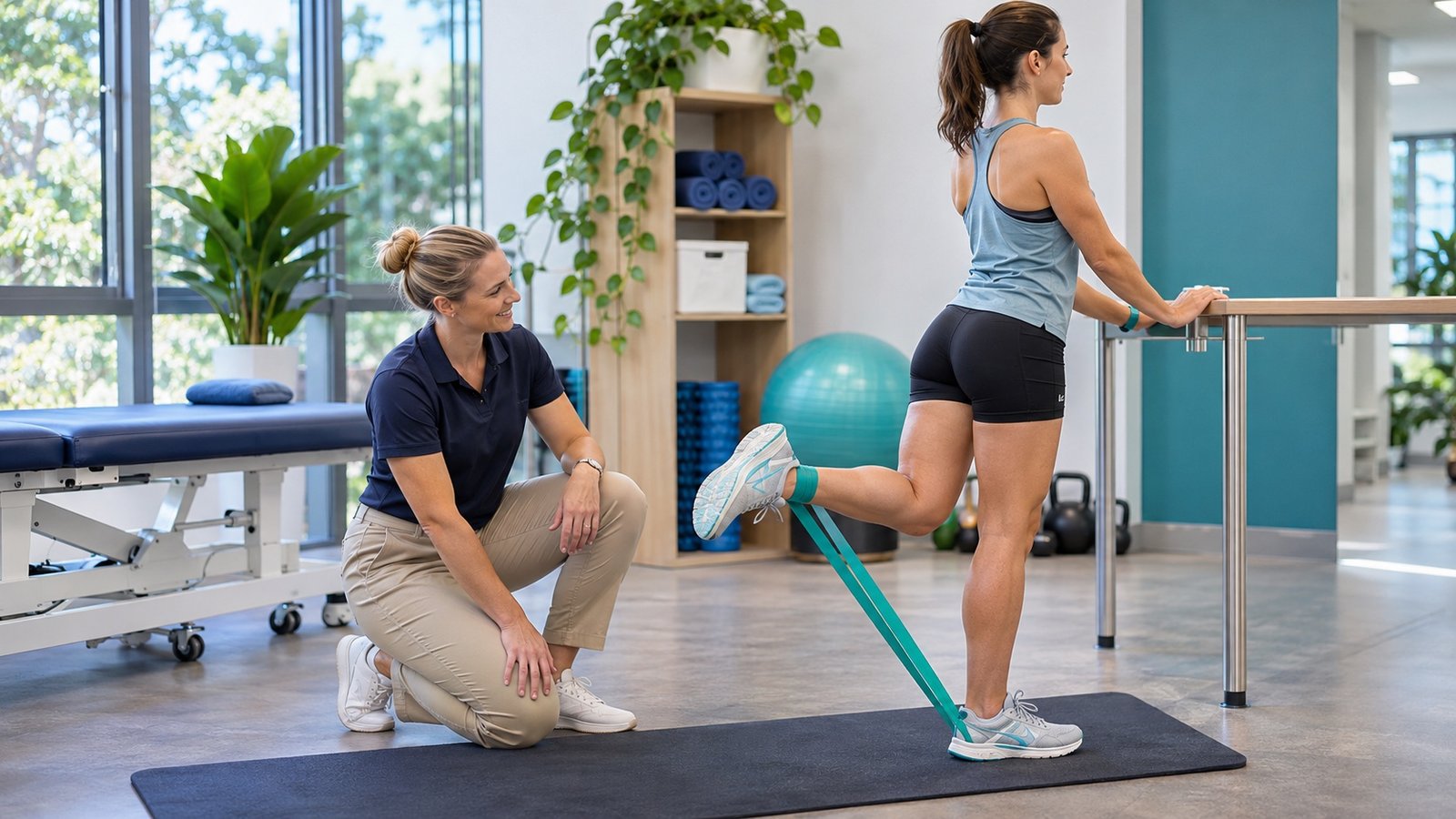
For some people, the pain is immediate and makes continuing impossible. Others experience a milder injury but notice discomfort when walking, bending or attempting to run again.
One of the most common questions after a hamstring injury is:
“How long until I can start running again?”
The answer depends on the severity and location of the injury, your symptoms, strength and the physical demands of the activity you want to return to.
Importantly, being able to walk without pain does not necessarily mean your hamstring is ready for sprinting.
Understanding how rehabilitation progresses can help you return to running with greater confidence.
The short answer
Returning to running after a hamstring strain should be based on your recovery and functional capacity rather than a fixed number of days.
Milder injuries may allow a relatively early return to gentle running, while more significant injuries can require substantially longer rehabilitation.
A progressive program commonly involves restoring comfortable movement, rebuilding hamstring strength, gradually reintroducing running and eventually preparing for higher-speed activities.
The goal is not simply to become pain-free. It is to restore the strength and capacity required for your sport or activity.
What is a hamstring strain?
The hamstrings are a group of muscles located at the back of your thigh.
They include:
- Biceps femoris
- Semitendinosus
- Semimembranosus
These muscles contribute to bending the knee, extending the hip and controlling the leg during running.
During sprinting, the hamstrings experience substantial forces as they help control and propel the lower limb.
A hamstring strain occurs when muscle or musculotendinous tissue is injured, often during a sudden increase in loading or an overstretching movement.
Hamstring injuries are particularly common in sports involving sprinting, acceleration, kicking and rapid changes of direction.
These include rugby league, soccer, AFL, athletics and Oztag.
What does a hamstring strain feel like?
Symptoms vary depending on the injury.
Common features include:
- Sudden pain at the back of the thigh
- A pulling or tearing sensation
- Pain when accelerating or sprinting
- Discomfort when bending the knee against resistance
- Tenderness around the injured area
- Reduced hamstring strength
- Difficulty walking normally
- Bruising or swelling in some cases
More significant injuries may cause substantial weakness, extensive bruising or difficulty bearing weight.
Not every pain at the back of the thigh is a hamstring strain.
Other possible causes include proximal hamstring tendon problems, referred pain from the lower back or irritation of neural structures.
A clinical assessment can help identify the likely source of symptoms.
What should you do immediately after pulling your hamstring?
The initial priority is to protect the injured area from further aggravation while maintaining appropriate movement.
Stop the activity that caused the injury
If you experience sudden hamstring pain while sprinting, continuing to run at high speed may aggravate the injury.
Avoid repeatedly testing whether you can sprint again immediately after the incident.
Modify activity temporarily
During the early stages, activities that substantially increase symptoms may need to be reduced.
This could include sprinting, jumping, heavy hamstring strengthening or aggressive stretching.
However, complete inactivity is not usually necessary for an uncomplicated strain.
Gentle movement and walking may be appropriate when tolerated.
Avoid aggressive stretching
Stretching a freshly injured hamstring aggressively is unlikely to be helpful.
In the early stages, forcing the muscle into a painful lengthened position may aggravate symptoms.
Restoring movement is important, but the amount and timing should reflect your injury.
Consider an early assessment
An assessment can help determine the likely severity of the injury, identify any concerning findings and establish an appropriate rehabilitation plan.
If you experienced a substantial popping sensation, severe weakness, extensive bruising or pain high near the sitting bone, prompt medical assessment is particularly important.
These findings can sometimes indicate a more significant injury, including tendon avulsion.
How long does a hamstring strain take to recover?
There is no single recovery timeframe.
Hamstring strains vary considerably in severity, location and the tissues involved.
A mild injury may settle relatively quickly, while a more significant strain can require several weeks or months of rehabilitation.
Factors influencing recovery include:
- Injury severity and location
- Previous hamstring injuries
- Pain and strength loss
- Walking tolerance
- Hamstring flexibility and movement
- Running requirements
- Sporting demands
- Response to rehabilitation
The amount of time since the injury is only one consideration.
Someone who can jog comfortably may still be unable to tolerate the forces associated with sprinting.
This is why return-to-sport decisions should include functional testing rather than relying solely on a calendar.
What exercises help hamstring strain recovery?
Exercise rehabilitation is an important part of recovery.
The exercises selected should change as your hamstring becomes stronger and more capable.
A program may progress through several overlapping stages.
Stage 1: Restore comfortable movement and basic strength
Early rehabilitation often focuses on maintaining movement and introducing tolerable muscle loading.
Depending on the injury, exercises may include:
- Gentle active knee movement
- Supported hamstring isometric exercises
- Low-load bridges
- Comfortable walking
- Other controlled lower-limb movements
Isometric exercises involve producing muscle force without substantial joint movement.
These may provide a useful starting point when more demanding movements are not yet tolerated.
Exercise intensity should be matched to the injury rather than automatically following a fixed protocol.
Stage 2: Progress hamstring strengthening
As symptoms and function improve, strengthening can become more challenging.
Exercises may include:
- Hamstring bridges
- Hamstring curls
- Romanian deadlifts
- Hip-hinge exercises
- Progressive single-leg strengthening
- Controlled eccentric hamstring exercises
Eccentric exercises involve the muscle producing force while lengthening.
These exercises are an important component of many evidence-informed hamstring rehabilitation programs.
However, the appropriate exercise and loading depend on the stage of recovery.
Stage 3: Introduce higher-level strengthening
Later rehabilitation may involve greater resistance and exercises performed through longer muscle lengths.
Examples include progressively loaded Romanian deadlifts, sliding hamstring curls and appropriately introduced Nordic hamstring exercises.
The Nordic hamstring exercise can be demanding and should not automatically be introduced at full intensity immediately after injury.
Progression should reflect strength, symptoms and the athlete’s current capacity.
When can you start jogging after a hamstring strain?
Jogging can usually be considered when the injury has progressed sufficiently to tolerate the demands of running.
Before introducing jogging, a physiotherapist may assess:
- Walking without a significant limp
- Comfortable movement
- Hamstring strength
- Pain during resisted muscle testing
- Tolerance of lower-level exercises
- Response to previous rehabilitation sessions
A return-to-running program may begin with short intervals of gentle jogging separated by walking.
Running duration, speed and total volume can then be adjusted according to your response.
Being able to jog does not mean you are ready to sprint.
Jogging and maximal-speed running place very different demands on the hamstrings.
Why is sprinting different from jogging?
Sprinting requires substantially greater force production and faster muscle contractions than jogging.
During high-speed running, the hamstrings play an important role in controlling the lower limb and contributing to propulsion.
As running speed increases, the demands on the hamstrings also increase.
This means an athlete may feel comfortable during a steady jog but experience symptoms when accelerating or reaching higher speeds.
For sports involving sprinting, rehabilitation needs to prepare the hamstrings for these demands.
Gradually rebuilding running speed
A progressive running program may involve:
- Comfortable jogging
- Faster continuous running
- Controlled accelerations
- Progressively higher-speed running
- Sport-specific sprinting
- Repeated sprint efforts
The exact progression depends on the individual.
Speed, distance, repetitions and recovery periods should be adjusted according to the athlete’s current capacity.
Attempting maximal sprinting before completing an appropriate progression may increase the risk of aggravating the injury.
How do you know when you are ready to return to sport?
Returning to sport involves more than being able to run in a straight line.
For someone playing rugby league, soccer or Oztag, the hamstrings need to tolerate a combination of:
- Acceleration
- High-speed running
- Deceleration
- Changes of direction
- Kicking where relevant
- Repeated sprint efforts
- Fatigue during training and competition
A return-to-sport assessment may include strength testing, movement assessment and progressively challenging running tasks.
Where appropriate, your physiotherapist may also compare the injured leg with the opposite leg.
However, strength symmetry alone does not guarantee readiness.
The athlete should demonstrate the capacity to perform the demands of their sport with an acceptable symptom response.
Why is completing training important?
A player may be able to complete one sprint without pain but struggle when required to repeat high-intensity efforts.
Training exposes the athlete to repeated running, acceleration and changes of direction.
Completing appropriately progressed training sessions can provide useful information about readiness for competition.
The return-to-sport decision should consider both physical capacity and confidence.
Can you prevent another hamstring strain?
No rehabilitation program can completely eliminate the risk of another injury.
However, several strategies may help reduce risk.
These include:
- Progressive hamstring strengthening
- Eccentric hamstring exercises
- Appropriate exposure to high-speed running
- Gradual increases in training load
- Sport-specific conditioning
- Adequate recovery between demanding sessions
Previous hamstring injury is a recognised risk factor for future injury.
This makes completing rehabilitation particularly important, even when symptoms have improved.
The Nordic hamstring exercise has evidence supporting its inclusion in injury-prevention programs, but it should form part of a broader approach rather than being treated as a guaranteed solution.
Do you need an MRI for a hamstring strain?
Not every hamstring strain requires imaging.
A clinical assessment can often provide useful information about the injury and guide rehabilitation.
An MRI may be considered when there is concern about a more significant injury, tendon involvement, an uncertain diagnosis or when imaging is likely to influence management.
For example, significant weakness, extensive bruising or suspected proximal hamstring tendon avulsion may warrant further investigation.
Imaging findings should be interpreted alongside the clinical examination.
A scan alone does not determine whether an athlete is ready to return to sport.
When should you see a physiotherapist?
Consider a physiotherapy assessment if:
- You experience sudden hamstring pain while running
- Walking or normal movement is difficult
- Symptoms are not improving
- You have previously injured the same hamstring
- You are unsure when to resume running
- You want to return to sprinting or competitive sport
- You need guidance with strengthening and rehabilitation
Seek prompt medical assessment if you experience severe pain, substantial weakness, extensive bruising, inability to walk or signs of a significant tendon injury.
Hamstring injury rehabilitation in Moorebank
If you have injured your hamstring while running, training or playing sport, One Stop Physio provides physiotherapy and exercise rehabilitation at our Moorebank clinic.
Our physiotherapists can assess your symptoms, identify relevant strength and movement limitations and develop a rehabilitation plan based on your goals.
Treatment may include:
- Injury assessment
- Education and activity modification
- Progressive hamstring strengthening
- Exercise rehabilitation
- Running progression
- Functional testing
- Return-to-sport planning
Our Moorebank clinic also offers Exercise Physiology, which may be appropriate for patients requiring structured exercise progression, strength development or sports conditioning.
One Stop Physio Moorebank is located at 132 Nuwarra Road, Moorebank NSW 2170.
We support patients from Moorebank, Liverpool, Chipping Norton, Hammondville, Wattle Grove and surrounding South West Sydney suburbs.
Frequently asked questions
Can I run with a pulled hamstring?
Running may be appropriate at certain stages of recovery, but it depends on the injury and your current capacity. Gentle jogging and high-speed sprinting have different physical demands. A graded return-to-running program can help determine an appropriate progression.
How long should I rest after a hamstring strain?
There is no universal rest period. Early activity modification may be appropriate, followed by progressive movement and strengthening as tolerated. Prolonged complete rest is generally not the goal for an uncomplicated hamstring strain.
Are Nordic hamstring exercises good for recovery?
Nordic hamstring exercises can form part of later-stage strengthening and injury-prevention programs. They are demanding exercises and should be introduced at an appropriate stage rather than immediately after every injury.
How do I know when my hamstring is ready for sprinting?
Readiness depends on symptoms, strength, functional testing and tolerance of progressive running. Being able to jog comfortably is not enough on its own to establish readiness for maximal sprinting.
Can physiotherapy help prevent another hamstring injury?
Physiotherapy can help identify relevant strength and functional limitations and guide progressive rehabilitation. Strengthening, high-speed running exposure and appropriate training progression may reduce reinjury risk, although no program can eliminate it completely.
Sources and further reading
- APTA Orthopedics: Hamstring Strain Injury in Athletes (2022 clinical practice guideline)
- One Stop Physio: Ankle sprain rehabilitation and return to sport
- One Stop Physio: When an X-ray or scan may help
This article provides general health information and does not replace individual medical or physiotherapy assessment. Rehabilitation recommendations and recovery timelines depend on individual circumstances.
Ready to return to running or sport?
If a hamstring injury is limiting your ability to run, sprint, train or play sport, a physiotherapy assessment can help identify your current capacity and guide the next stage of rehabilitation.
Book a physiotherapy appointment at One Stop Physio Moorebank to discuss your injury and return-to-sport goals.
One Stop Physio Moorebank
132 Nuwarra Road, Moorebank NSW 2170
Phone: 0482 047 813
Appointments can be booked online through our Moorebank booking system.