


Hip pain · gluteal tendinopathy
Hip Pain When Lying on Your Side: What Helps?
Hip pain when lying on your side can make getting a comfortable night’s sleep frustrating.
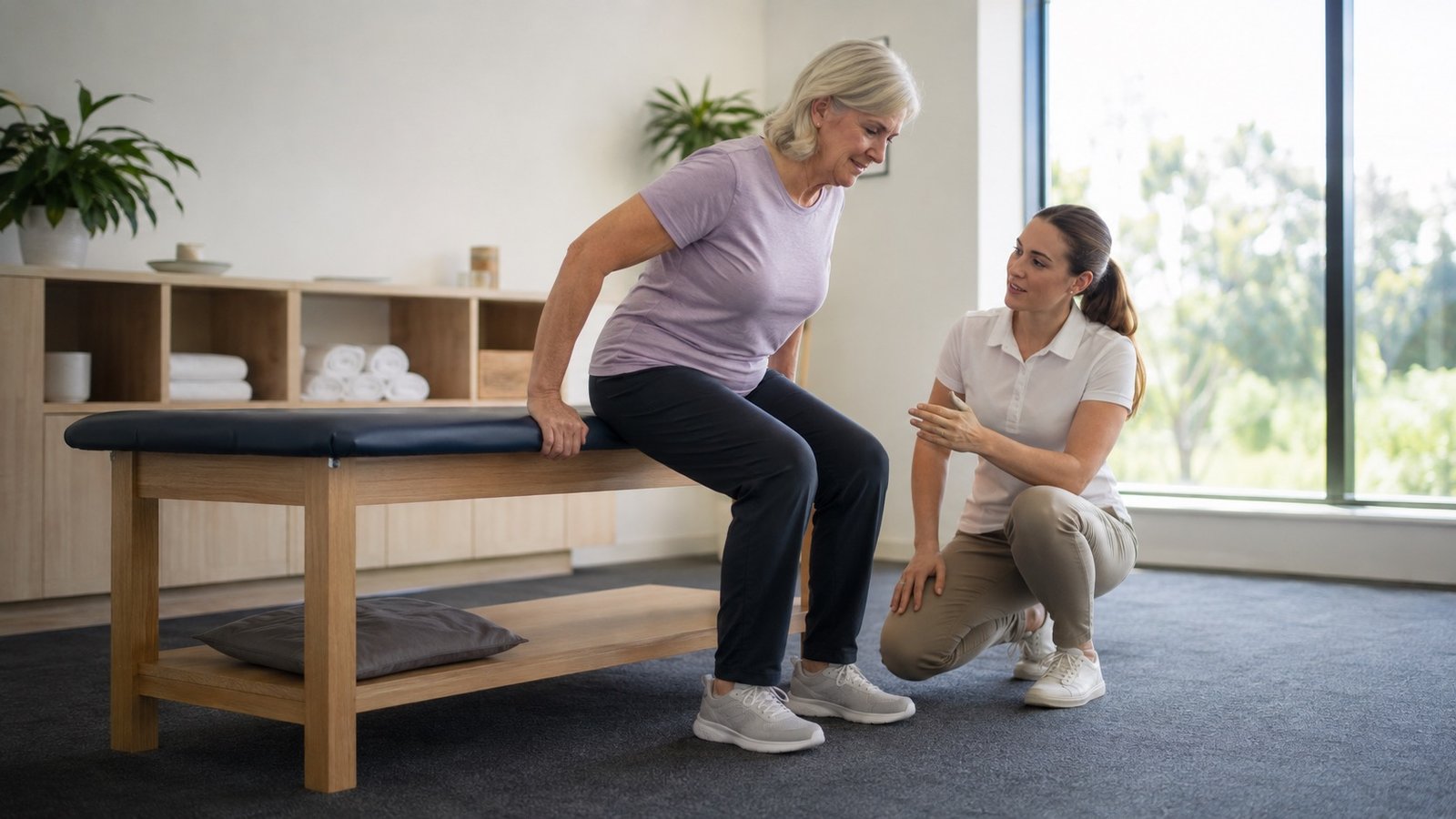
You may feel relatively comfortable during the day, only to notice an aching or sharp pain around the outside of your hip once you get into bed. For some people, the pain is worse when lying directly on the sore side. Others find that even lying on the opposite side can aggravate symptoms.
You might also notice discomfort when walking, climbing stairs, standing on one leg, getting out of a chair or returning to exercise.
One possible cause is greater trochanteric pain syndrome (GTPS), which commonly involves the gluteal tendons around the outside of the hip.
The good news is that this type of hip pain can often be managed with a combination of activity modification, improved sleeping positions and progressive strengthening.
Why does my hip hurt when I lie on my side?
Pain around the outside of the hip is commonly associated with structures around the greater trochanter, which is the bony area you can feel on the side of your upper thigh.
Several muscles and tendons attach around this region, including the gluteus medius and gluteus minimus.
These muscles help control your pelvis and hip when you:
- Walk
- Climb stairs
- Stand on one leg
- Run
- Change direction
- Get in and out of chairs
When the gluteal tendons become sensitive or irritated, pressure and certain positions can become uncomfortable.
This is why side sleeping can sometimes become one of the most noticeable symptoms.
What is greater trochanteric pain syndrome?
Greater trochanteric pain syndrome, or GTPS, is a term used to describe pain around the outer side of the hip.
It can involve the gluteal tendons, surrounding tissues and, in some cases, the nearby bursae.
People are sometimes told they have “hip bursitis”.
While bursae can contribute to symptoms, persistent outer-hip pain often involves the gluteal tendons as well. This is why clinicians increasingly use the broader term greater trochanteric pain syndrome rather than assuming every case is simply bursitis.
What does gluteal tendinopathy feel like?
Symptoms can vary, but common features include:
- Pain around the outside of the hip
- Tenderness when pressing on the side of the hip
- Pain when lying on the affected side
- Discomfort when sleeping on the opposite side
- Pain when climbing stairs
- Symptoms when walking longer distances
- Pain when standing on one leg
- Discomfort when getting out of a chair
- Pain during or after running
Some people also feel pain extending down the outside of the thigh.
These symptoms may be consistent with gluteal tendinopathy, but they do not confirm the diagnosis on their own.
Other conditions can also cause hip pain, including problems involving the hip joint or lower back.
Why is hip pain often worse at night?
Sleeping can place prolonged pressure on the tissues around the outside of the hip.
If you lie directly on the painful side, your body weight can compress the sensitive area against the mattress.
Even lying on the opposite side can sometimes cause discomfort.
This is because the top leg may drop across your body, placing the hip into an adducted position and increasing compression around the gluteal tendons.
Spending several hours in this position can contribute to night pain.
That does not mean you need to sleep sitting upright or construct a small fortress out of pillows, but a few positioning changes can make a difference.
What is the best sleeping position for outer hip pain?
There is no single sleeping position that works for everyone, but several adjustments may help.
Avoid lying directly on the painful side
If lying on the sore hip reliably aggravates your symptoms, temporarily avoiding that position may reduce direct pressure.
Place a pillow between your knees
If you sleep on your unaffected side, try placing a pillow between your knees.
For some people, supporting the ankles as well can be helpful.
The aim is to stop the top leg from dropping across your body and reduce compression around the painful hip.
Try sleeping on your back
Some people find lying on their back more comfortable.
A pillow underneath the knees may also improve comfort.
Adjust your mattress setup if needed
A very firm surface may increase direct pressure around the outer hip in some people.
That does not mean you need to immediately buy a new mattress.
It is usually more sensible to first experiment with positioning, pillows and other simple changes.
What activities can aggravate gluteal tendinopathy?
Certain positions and activities can place higher demands on the gluteal tendons.
Examples include:
- Standing with most of your weight on one leg
- Repeatedly crossing your legs
- Climbing a large number of stairs
- Long walks during a flare-up
- Hill running
- High-volume running
- Prolonged standing
- Exercises that repeatedly aggravate symptoms
These activities are not automatically harmful.
The issue is usually whether the current amount of load exceeds what your hip is able to tolerate comfortably.
Should you stop walking?
Not necessarily.
Complete rest is rarely the long-term solution.
If walking is causing a significant flare-up, temporarily reducing your distance or changing the terrain may be helpful.
For example, shorter walks on flatter ground may initially be better tolerated than long walks involving hills or stairs.
As your symptoms and strength improve, walking can be gradually increased again.
The goal is usually to maintain an appropriate amount of activity while progressively rebuilding capacity.
What exercises can help gluteal tendinopathy?
Progressive strengthening is commonly used as part of rehabilitation for gluteal tendinopathy.
The gluteal muscles help control the pelvis and hip during walking, standing, climbing stairs and sport.
The right exercises depend on your symptoms, current strength and goals.
Early-stage loading
If the hip is quite irritable, exercises may initially focus on gentle muscle activation.
These might include:
- Isometric hip abduction
- Supported standing hip exercises
- Low-load gluteal strengthening
The aim is to introduce appropriate loading without repeatedly provoking symptoms.
Progressive strengthening
As symptoms settle, exercises can become more challenging.
Examples may include:
- Resisted hip abduction
- Sit-to-stands
- Step-ups
- Squats
- Single-leg control exercises
- Progressively loaded lower-limb strengthening
Resistance and difficulty should increase as your capacity improves.
Returning to normal activity
Later rehabilitation should reflect what you actually need your hip to do.
For one person, that might mean walking comfortably around the shops.
For another, it could mean returning to:
- Running
- Gym training
- Hiking
- Sport
- Prolonged standing at work
The purpose of rehabilitation is not simply to become good at physiotherapy exercises.
It is to help you return to the activities that matter to you.
Should you stretch a painful hip?
Not always.
Some commonly used hip stretches can increase compression around the gluteal tendons.
For example, aggressively pulling the painful leg across the body may increase pressure over the outer hip in some people.
That does not mean stretching is always inappropriate.
It means the type of exercise should be chosen based on your individual presentation.
For many people with gluteal tendinopathy, strengthening and load management are more important than simply stretching the sore area.
Is some pain during exercise okay?
A small amount of discomfort during rehabilitation may be acceptable for some people.
What matters is how the hip responds overall.
Useful questions include:
- Does the pain settle after exercise?
- Is the hip substantially worse later that day?
- Is night pain worse after the session?
- Is walking becoming easier over time?
- Are stairs becoming easier?
- Is strength improving?
If an exercise repeatedly causes a significant or prolonged flare-up, the program may need adjusting.
That could involve changing:
- Resistance
- Number of repetitions
- Range of movement
- Frequency
- Exercise selection
A useful rehabilitation program should challenge the hip without repeatedly overwhelming it.
Do you need an ultrasound or MRI?
Not everyone with outer-hip pain requires imaging.
A clinical assessment can often provide useful information about whether symptoms appear consistent with greater trochanteric pain syndrome.
Your physiotherapist may assess:
- Where your pain is located
- Which activities aggravate symptoms
- Hip movement
- Gluteal strength
- Single-leg balance
- Walking
- Functional movements
- Relevant lower-back symptoms
Imaging may be considered when the diagnosis is unclear, another condition is suspected or symptoms are not progressing as expected.
A scan should always be interpreted alongside your symptoms and physical findings.
Do corticosteroid injections help?
Corticosteroid injections may provide short-term symptom relief for some people.
However, injections do not necessarily address the strength, activity or load-management factors that may contribute to persistent symptoms.
For this reason, exercise and education remain important parts of rehabilitation.
An Australian randomised controlled trial comparing education plus exercise, corticosteroid injection and a wait-and-see approach found that education and exercise produced better patient-reported global improvement at both short-term and long-term follow-up.
Injection decisions should be discussed with an appropriate medical practitioner.
How long does gluteal tendinopathy take to improve?
There is no universal recovery timeline.
Some people notice improvements relatively quickly after changing aggravating activities and starting an appropriate strengthening program.
Others may experience symptoms for several months.
Recovery can be influenced by:
- How long symptoms have been present
- Current strength
- Activity levels
- Sleep disturbance
- Work demands
- Overall health
- Consistency with rehabilitation
The goal should be steady improvement in function and tolerance rather than expecting one particular exercise to fix the problem instantly.
Sadly, tendons remain immune to motivational speeches.
When should you see a physiotherapist?
Consider having your hip assessed if:
- Pain regularly disrupts your sleep
- Symptoms are not improving
- Walking is becoming difficult
- Stairs are painful
- You are avoiding exercise because of pain
- Symptoms are progressively worsening
- You are unsure whether the pain is coming from the hip or lower back
A physiotherapy assessment can help determine what may be contributing to your symptoms and establish an appropriate rehabilitation plan.
Hip pain physiotherapy in Moorebank
If hip pain is affecting your sleep, walking, gym training or everyday activities, One Stop Physio provides physiotherapy at our Moorebank clinic.
Our physiotherapists can assess your symptoms, identify relevant strength and movement limitations and guide a rehabilitation plan based on your individual goals.
Treatment may include:
- Education
- Activity modification
- Progressive strengthening
- Exercise rehabilitation
- Hands-on treatment where clinically appropriate
One Stop Physio Moorebank is located at 132 Nuwarra Road, Moorebank NSW 2170.
Physiotherapy is provided by Christian Tarabey and Simon De Biasi, with Exercise Physiology also available at the Moorebank clinic.
The clinic supports patients from Moorebank, Liverpool, Chipping Norton, Hammondville, Wattle Grove and surrounding South West Sydney suburbs.
Having both Physiotherapy and Exercise Physiology available at Moorebank can also be useful for patients who need a longer-term progression from pain management into broader strength, conditioning and exercise rehabilitation.
Frequently Asked Questions
Why does my hip hurt when I sleep on my side?
Pain around the outside of the hip can be associated with greater trochanteric pain syndrome. Pressure on the tissues around the side of the hip during sleeping may aggravate symptoms.
Is walking good for gluteal tendinopathy?
Walking can remain part of your routine, although distance and terrain may need to be adjusted during a flare-up. The goal is to maintain appropriate activity while gradually improving the hip's capacity.
Should I stretch or strengthen my hip?
Progressive strengthening is commonly used for gluteal tendinopathy. Some stretches may increase compression around the outer hip, so exercise selection should be based on your individual symptoms and assessment.
How long does gluteal tendinopathy take to improve?
Recovery varies. Some people improve within several weeks, while others require several months of progressive rehabilitation.
Can physiotherapy help hip pain at night?
Physiotherapy can help assess the cause of your symptoms and provide advice on sleeping positions, activity modification and progressive strengthening where appropriate.
This article provides general health information and does not replace individual medical or physiotherapy assessment.
Book a physiotherapy appointment in Moorebank
If persistent hip pain is affecting your sleep or limiting your normal activities, a physiotherapy assessment may help clarify what is contributing and what you can do next.
Book a physiotherapy appointment at One Stop Physio Moorebank for an individual assessment and rehabilitation plan based on your symptoms and goals.